Eye tricks guide
How to See Hidden 3D Images: Parallel and Cross-Eyed Viewing, Step by Step
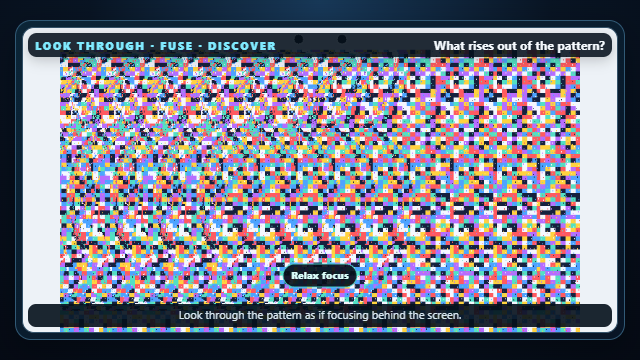
A stereogram looks like noise or a busy pattern until, suddenly, a shape lifts off the page. Nothing about the image changes in that moment; what changes is where your two eyes are aimed. This guide explains the two viewing methods, gives you concrete exercises for each, lists the mistakes that keep most people stuck, and explains in plain terms why a flat picture can hold a 3D shape.
Two kinds of 3D image, two ways of looking
There are two common formats. A single-image stereogram, the style made famous by the Magic Eye books, is one picture built from a repeating pattern. A stereo pair is two nearly identical pictures placed side by side. Both work the same way underneath: each eye has to receive a slightly different view, and your brain merges the two views into depth.
What differs is how you aim your eyes. In parallel viewing, sometimes called wall-eyed or divergent viewing, you look as if through the picture at something far behind it, so your eyes point almost straight ahead. In cross-eyed viewing, you aim both eyes at a point in front of the picture, so the lines of sight cross before they reach the screen.
An image is designed for one method. Most single-image stereograms are made for parallel viewing. Side-by-side pairs are labeled either parallel or cross-view. If you use the wrong method, you usually still see depth, but it comes out inside out: the shape that should float toward you sinks into a hole instead. That inversion is a useful clue that you are fusing correctly but with the other method.
Why it works: binocular disparity in plain terms
Your eyes sit a few centimeters apart, so each one sees the world from a slightly different spot. Hold up a finger and close one eye, then the other: the finger jumps against the background. Near objects jump more than far ones. That difference between the two eye views is called binocular disparity, and your visual system reads it as distance.
A stereogram fakes that difference. In a single-image stereogram, the pattern repeats across the picture at a set spacing. When your eyes aim so that each one lands on a neighboring copy of the pattern, the two copies line up and look like one surface. Where the artist made the spacing slightly narrower or wider, the matched copies imply a slightly different distance, and that region appears closer or farther. The hidden object is simply an area where the repeat spacing was nudged.
The tricky part is that your eyes normally aim and focus together. Look at something far away and your eyes both point outward and focus far. A stereogram asks you to aim your eyes at one distance while keeping the screen in focus at another. That split feels odd at first, which is why the first success takes practice and later ones come quickly.
Parallel (wall-eyed) viewing, step by step
Parallel viewing is the method for most hidden-picture stereograms. Use a screen at normal brightness, sit comfortably, and keep your head level so both eyes are at the same height relative to the image.
If the image has two guide dots above it, they are your best tool. When you are not aiming correctly you see two dots. As your eyes relax outward, each dot doubles, and you see four. When the inner two overlap exactly, you see three dots in a row, with the middle one usually looking solid. Hold that three-dot view and drift your attention down into the pattern without moving your eyes.
- Bring your face close to the screen, close enough that the picture is a blur. At this distance your eyes cannot converge on the surface and naturally point near parallel.
- Keep looking straight through the blur as if at a wall behind it. Do not try to focus.
- Slowly move back, a few centimeters at a time, keeping the same far-away gaze. Let the pattern come into focus on its own.
- When the texture starts to look layered or shimmery, stop moving and wait. The shape usually firms up over several seconds.
- Alternative: if your screen is glossy, find the reflection of an object behind you and look at that reflection. Your eyes are then aimed behind the screen surface, which is exactly where they need to be.
Cross-eyed viewing, step by step
Cross-eyed viewing is used for side-by-side stereo pairs labeled cross-view. Many people find it easier to start than parallel viewing, because crossing your eyes is a deliberate action you can control.
The finger method is the most reliable way to learn it. Sit at arm's length from the screen with the pair in front of you. Hold a fingertip upright about halfway between your eyes and the screen, centered between the two pictures. Look at your fingertip, not the screen. In the background you will see the two pictures double into four. Move the finger slowly toward or away from your face until the middle two pictures overlap into one. You now see three pictures, with the center one being the fused 3D view.
Keep your eyes where they are and lower the finger out of the way. Shift your attention, not your aim, to the middle picture. It will often be blurry at first; give your focus a few seconds to catch up while your eyes stay crossed. If the center image slides apart, bring the finger back and reset.
Smaller is easier. If the two pictures are wider than a few inches each, step back from the screen or shrink the browser zoom. The less your eyes have to cross, the more comfortable it is.
Common mistakes that keep you stuck
Almost everyone who struggles is making one of a small number of errors. Going through this list usually turns a frustrating session into a successful one.
- Trying too hard. Staring and straining keeps your eyes locked on the surface. Relaxed, unfocused looking works better for parallel viewing.
- Image too large for parallel viewing. Your eyes cannot comfortably point outward past parallel, so if the repeat spacing in a stereogram is wider than the distance between your pupils, it cannot be fused that way. Shrink it.
- Tilted head. If one eye sits higher than the other, the matching patterns will not line up. Keep your eyes level with the image.
- Moving the image while looking. Scrolling or bumping the screen breaks the alignment. Settle the page first, then look.
- Giving up at the shimmer. A flickering or layered texture means you are close. Hold steady and wait several seconds instead of resetting.
- Expecting a sharp picture instantly. The shape often appears as a faint outline first and sharpens as your focus adjusts.
Comfort and when to stop
Stereogram viewing should feel like a curiosity, not a workout. Take short sessions, blink normally, and look away at something distant between images. If you feel eye strain, a headache, dizziness, or any discomfort, stop and rest. It is fine to come back another day or to skip stereograms entirely.
Some people cannot fuse stereograms at all, or can only manage one method. That is common and nothing to force. This guide covers viewing technique only; it is not medical advice, and if you have questions about your eyes or vision, ask an eye care professional rather than relying on puzzle practice.
Practice with Hidden 3D and Cross Your Eyes
BeanNest has one free browser game for each method. Hidden 3D uses parallel viewing only: each colorful single-image stereogram includes two guide dots, so you can aim for the three-dot view described above, then answer I can see it, Reveal, or Skip. The reveal shows the hidden object and its grayscale depth map, and Look again takes you back to the same picture so you can try once you know what to look for. There are sixty hidden objects, from animals and vehicles to weather and kitchen items, and no timer.
Cross Your Eyes uses cross-eyed viewing on side-by-side stereo pairs. Fuse the pair, then pick which shape floats closest to you: Orb, Cube, Star, or Gem. You can reveal the depth order at any time, and nothing requires you to see the 3D effect to continue.
A good learning path is to start with whichever method feels more natural, get three or four successes in a row, and only then try the other. Switching back and forth on day one tends to confuse your eyes about which direction to aim.
Frequently asked questions
Why does the hidden shape look like a hole instead of popping out?
You fused the image with the opposite method to the one it was designed for. A parallel-view image seen cross-eyed, or a cross-view pair seen wall-eyed, shows inverted depth. Switch methods and the shape will float forward.
Do I need special glasses to see a stereogram?
No. Autostereograms and side-by-side stereo pairs are designed to be viewed with the naked eye. Glasses are only needed for other 3D formats, such as red and cyan anaglyphs.
Is it easier on a phone or a computer?
Parallel viewing is often easier on a phone because the image is small, so the repeat spacing stays narrower than the distance between your eyes. Cross-eyed pairs are fine on either, as long as the pictures are not very large.
What if I still cannot see anything after trying?
Try the other method, shrink the image, and keep sessions short. Some people never fuse stereograms, and that is fine. Stop if your eyes feel uncomfortable.