Card game guide
How to Get Better at Memory Matching Games: Find Every Pair in Fewer Moves
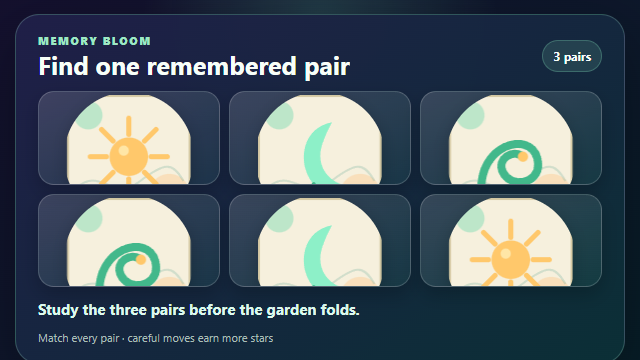
Memory matching, also called Concentration or Pairs, looks like a pure test of recall, but how you flip matters as much as what you remember. Two players with the same memory can finish the same board with very different move counts. This guide covers the habits that cut wasted turns: a fixed flipping order, grouping cards by row, naming what you see, and a simple rule for the second card. A worked game at the end shows every decision.
How a move works, and what counts as waste
Cards start face down. On each turn you flip two. If they match, they stay face up; if not, they flip back. Your score is usually the number of turns, or moves, you needed to clear the board.
There is a hard floor: a board with six pairs needs at least six moves, because each move can clear at most one pair. Everything above that floor comes from two sources. Some moves are unavoidable exploration, because you cannot match cards you have never seen. The rest are waste: flipping a card you already know without a reason, forgetting a card you saw, or failing to take a match you could have made. Good play means accepting the first kind and eliminating the second.
Flip in a fixed order
The single most useful habit is to explore the board systematically, for example left to right along the top row, then the next row. Random flipping scatters what you know across the grid, and your memory has to hold isolated points. Systematic flipping keeps the known area as one solid block and the unknown area as another, so you always know where the next new card is.
It also removes a decision. When you are not cashing in a known pair, the next card to flip is simply the first unseen card in your order. That frees attention for the part that matters: remembering what you saw.
Chunk locations by row and build verbal labels
Remembering twelve separate card positions is hard. Remembering three rows of four is easier, because each row becomes one short sequence. As you reveal cards, rehearse each row as a phrase: top row, sun, leaf, fox, sun. Middle row, bee, leaf. A short list is easier to hold than a scattered map.
Name each card in a word, quietly or in your head, the moment it turns over. A word is easier to recall than a fleeting image, especially when pictures look similar. Use the most distinctive name you can: red fox is better than animal. If two pictures are easy to confuse, give them clearly different names at once.
Anchor positions to the edges. Corners and edge cards are easier to locate than cards in the middle of a large grid. Labels like fox, top right, or bee, second row first card give each memory a fixed address instead of a vague sense of somewhere in the middle.
The second-card rule
Most wasted moves happen on the second flip of a turn. Use this decision routine every time:
- If you already know where both cards of a pair are, flip that pair now. It costs one move whenever you take it, and clearing it reduces what you must remember.
- Otherwise, flip the next unseen card in your order.
- If it matches a card you have already seen, flip that known card and take the match.
- If it is new, flip another unseen card, not a known one. A known card is a guaranteed miss that teaches you nothing; an unseen card might match by luck and always adds information.
- When only one pair is left face down, it is a free match. Take it.
A worked game, turn by turn
Here is a six-pair board laid out in three rows of four. Rows are A, B, and C from top to bottom, and columns 1 to 4 from left to right. The hidden layout is: A row sun, leaf, fox, sun; B row bee, leaf, fox, moon; C row bee, moon, star, star. Follow along to see the rule in action.
Move 1: flip A1, sun, and A2, leaf. New and new, a miss. Known: sun A1, leaf A2.
Move 2: flip A3, fox. It matches nothing known, so the second flip goes to the next unseen card, A4, sun. Fox and sun do not match, but now both suns are located.
Move 3: cash in the known pair, A1 and A4. Sun matched.
Move 4: flip B1, bee, then B2, leaf. A miss, but leaf now has both positions known.
Move 5: take leaf at A2 and B2. Matched.
Move 6: flip B3, fox. Fox is already known at A3, so flip A3. Matched.
Move 7: flip B4, moon, which is new, then C1, bee. A miss, but both bees are now known.
Move 8: take bee at B1 and C1. Matched.
Move 9: flip C2, moon, which matches B4. Matched.
Move 10: only C3 and C4 remain, so they must be the stars. Free match.
Ten moves for six pairs. Notice that no move flipped a known card unnecessarily and no seen card was forgotten. The extra four moves above the six-move floor were pure exploration, and how many you need depends on the deal. Without the rules, the typical slip happens on move 2: after the fox turned out to be new, flipping the known leaf at A2 as the second card would have been a certain miss that taught nothing, and the second sun would still be hidden.
Small habits that save moves
A few more habits make a noticeable difference over a session.
- Use any preview window. If the game shows all cards briefly at the start, spend it on one row or a few distinctive pictures rather than trying to absorb everything.
- Say the pair out loud when a miss reveals the second copy of something. That is the moment you are most likely to remember it.
- Do not rush the flip-back. Look at both mismatched cards for the full time they are shown and name them before they hide.
- Start on smaller boards. Build the habits on a few pairs, then move up a size.
- Count your moves against the board. Knowing that six pairs need at least six moves keeps your target concrete.
Practice in Memory Bloom
Memory Bloom: Pair Garden is a free BeanNest memory matching game with four board sizes: Sprout with 3 pairs, Grove with 6, Bloom with 8, and Canopy with 10. Grove uses the same three-by-four layout as the worked example above. An optional preview shows the cards briefly before play, and you can turn it off once you want a pure test. Stars are based on moves: three stars for finishing within your pair count plus two, two stars within double the pair count. Time never reduces your stars, so there is no reason to rush.
Classic mode keeps cards where they are, which is where every technique in this guide applies directly. Crazy Shuffle Storm mode moves the unmatched cards to new positions after every miss, while matched pairs stay in place. That breaks location memory on purpose, so treat it as a separate challenge: in Crazy, what you learned about unmatched cards before a miss no longer points to the right spot. You can also switch between five original picture packs, which changes the artwork without changing the game.
Frequently asked questions
What is the minimum number of moves to finish a memory game?
One move per pair. A six-pair board can never be cleared in fewer than six moves, and reaching that requires lucky first flips. Good play keeps you close to the floor by avoiding wasted moves.
Should I flip a card I know or a new card second?
If your first card matches a known card, flip the known one. If your first card is new, flip another new card. Flipping a known non-matching card is a guaranteed miss with no new information.
How do I remember cards that look similar?
Give them clearly different names the moment you see them, and attach each to its row and an edge or corner. Distinct words are easier to keep apart than similar images.
Does the preview make the game too easy?
It shortens exploration on small boards, but on larger boards you still cannot hold everything. In Memory Bloom the preview is optional, so turn it off whenever you want more challenge.