Puzzle strategy
Minesweeper Strategy: Read the Numbers, Learn the Patterns, Guess Less
Minesweeper looks like a game of luck until you learn to read the numbers. Most of the board can be cleared by logic, and a handful of recurring number patterns do the bulk of that work. This guide covers the opening, the core reading habits, the four patterns worth memorizing, when to flag versus chord, and how to take the occasional forced guess with the best odds available.
The opening move
Every number on a revealed cell counts the mines among its up to eight neighbors. A blank revealed cell means zero, and the game automatically opens all of its neighbors, which is why one lucky click can clear a large patch at once.
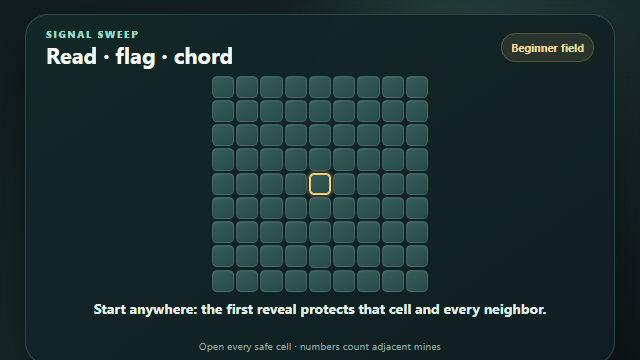
In many Minesweeper versions the first click is only guaranteed not to be a mine, so it can land on a lone number that tells you very little. Signal Sweep protects the first cell you reveal and all of its neighbors, so the first click always opens an area to work from. That means you do not need opening tricks: click anywhere, then switch to reading the boundary.
Once the opening appears, resist the urge to click around for another one. Work the edge of the opened area first. Nearly every first opening contains enough information to keep going by logic alone for a while.
Reading numbers: the two basic deductions
All Minesweeper logic comes back to two questions you ask about a single number. First: does it have exactly as many hidden neighbors as its value? If a 2 touches exactly two hidden cells, both are mines. Second: does it already touch as many known mines as its value? If a 2 touches two flagged mines, every other hidden neighbor is safe.
The next step is subtraction. When a number already touches some known mines, subtract them to get its remaining count. A 3 next to one flagged mine behaves like a 2 for its other hidden neighbors. Many apparently hard spots turn into simple ones once you mentally reduce every number this way.
Finally, compare neighboring numbers. Two numbers that share some hidden cells constrain each other, and the difference between what they see is often where the safe cell or the certain mine hides. Every pattern in the next section is just this comparison, done often enough that you recognize it on sight.
The patterns worth memorizing
Each pattern below assumes a straight boundary: a row of revealed numbers with a row of hidden cells directly above it, and nothing else hidden around those numbers. Read the positions left to right.
The 1-1 at a wall. A 1 sits against the edge of the board or against already cleared cells, so it touches only two hidden cells, A and B. The next 1 along touches A, B, and C. The first 1 says one mine is in A or B. The second 1 also has exactly one mine, and it is already accounted for by A or B, so C is safe.
The 1-2. A 1 sits beside a 2. The 2 sees three hidden cells: the one above the 1, the one above itself, and the one beyond it on the far side. The 1 can supply at most one mine to the two cells it shares with the 2, so the 2 must get its second mine from the third cell. The hidden cell on the far side of the 2, away from the 1, is a mine.
The 1-2-1. Apply the 1-2 rule from both ends. The 1-2 on the left marks the cell above the right-hand 1 as a mine, and the 1-2 on the right marks the cell above the left-hand 1 as a mine. The 2 is now satisfied, so the cell directly above the 2 is safe, and so are the cells beyond each 1. In short: mines above the 1s, safe above the 2.
The 1-2-2-1. The same reasoning gives the opposite layout. The left 1-2 marks the cell above the second 2 as a mine, and the right 1-2 marks the cell above the first 2 as a mine. Each 2 now sees its two mines, so the cells above the two 1s are safe. In short: mines above the 2s, safe above the 1s.
- 1-1 at a wall: the third cell along is safe.
- 1-2: the cell past the 2, on the side away from the 1, is a mine.
- 1-2-1: mines above both 1s, the cell above the 2 is safe.
- 1-2-2-1: mines above both 2s, the cells above the 1s are safe.
Patterns hide behind other numbers
Real boards rarely show a clean 1-2-1. More often you see something like 2-3-2 along a boundary, with a row of flagged mines further down that each number already touches. Subtract the mines each number already sees, and the 2-3-2 may become a 1-2-1 in disguise.
The same goes for corners and bends in the boundary. When a pattern wraps around a corner, the numbers see different sets of cells than they would on a straight edge, so check each neighbor individually rather than trusting the shape. The patterns are shortcuts for the reasoning, not a substitute for it.
Flagging versus chording
Some players flag every mine they find. Others flag almost nothing and clear safe cells directly. Both styles win; the difference is speed and how much you trust your own counting.
Chording is the technique that makes flagging pay off. When a revealed number already has as many flags around it as its value, activating that number reveals all of its other hidden neighbors at once. In Signal Sweep you chord by clicking a revealed number whose flag count matches, or by pressing Enter or Space on it with the keyboard. One action can clear several cells.
The risk is that chording trusts your flags completely. A wrong flag makes the game open a real mine. So flag only cells you have proven, and if a chord feels uncertain, reveal the cells one at a time instead.
A practical middle ground: flag mines that sit next to several numbers you still need to chord, and skip flagging isolated mines that only affect one number. On a phone, Signal Sweep's Reveal and Flag tap modes make that choice explicit, and a long press works as an optional flag shortcut.
When guessing is forced, and how to guess well
Sometimes no logical move exists. The classic case is two hidden cells, one mine, and no number anywhere that can ever tell them apart. Before accepting that, check every number on the boundary once more, including subtraction and the patterns above. Forced guesses are less common than they feel.
When the guess really is forced, compare the odds rather than clicking the first cell you see. A cell next to a 1 that touches three hidden cells is a mine one time in three, about 33 percent. A cell far from any number is roughly a mine at the rate of the board's remaining mines divided by its remaining hidden cells. Early on a field with 99 mines in 480 cells, that is about 20 percent, which is better odds than the cell beside the 1.
Odds are not the only factor. Prefer a guess that, if it is safe, will reveal useful information, such as a cell likely to open a blank area or connect two stuck regions. And if a true 50-50 will never be resolved by any future number, take it now rather than at the end. The odds are the same either way, and you lose less time if it goes wrong.
Near the end of a game, the mine counter becomes evidence too. If three hidden regions remain and the counter says two mines are left, that total can settle a situation that local numbers cannot.
Practicing the patterns
The fastest way to learn patterns is to say them out loud as you play: this is a 1-2, so that cell is a mine. After a few dozen games you start to see them before you consciously count.
Signal Sweep includes classic Beginner, Intermediate, and Expert fields plus a denser Standard default and a 130-mine Master challenge, so you can practice reading on small boards before taking patterns onto the large ones. Beginner is the easiest place to drill the 1-2 and 1-2-1, while Expert boards show many more disguised patterns along long boundaries.
Frequently asked questions
Is Minesweeper mostly luck?
No. Most cells on a typical board can be resolved by logic, especially once you know the common patterns and use subtraction. Luck only matters when a position is genuinely undecidable, and even then you can choose the guess with the best odds.
Do I have to flag mines to win?
No. You win by revealing every safe cell, so flags are a tool rather than a requirement. Flagging is mainly useful because it lets you chord, which clears several neighbors of a number in one action.
Why did my chord hit a mine?
Chording reveals every unflagged neighbor of a number once the flag count matches its value. If one of those flags was on a safe cell, the real mine is among the cells that get revealed. Only flag cells you have proven to be mines before chording around them.
What is the best cell to click when I have to guess?
Compare odds. A cell next to a number has a probability set by that number and its hidden neighbors, while a cell far from any number has roughly the board's overall remaining mine density. Pick the lower one, and when two options are close, prefer the cell more likely to open new information.