Word game guide
Five-Letter Word Guessing Strategy: From First Guess to Final Letter
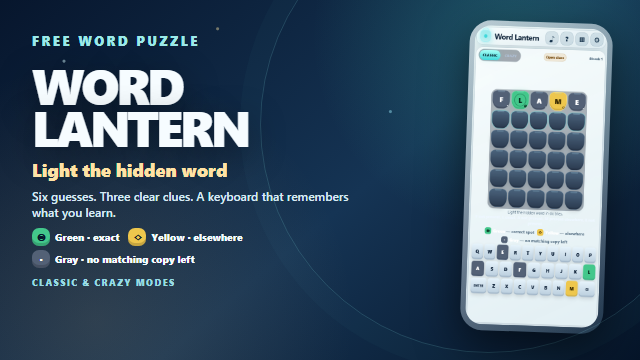
Five-letter word guessing games look like a vocabulary test, but they reward method more than a big vocabulary. Each guess is a question, and the colored clues are the answer. This guide covers how to choose an opening word, how to read every clue including the confusing double-letter cases, how to think under hard-mode rules, and how to avoid the classic trap where many words differ by one letter.
How the puzzle works
A hidden five-letter word is chosen, and you have a fixed number of guesses, usually six. Every guess must be a real word. After each guess, every letter gets a clue: green means the letter is in the word at that exact position, yellow means the letter is in the word but somewhere else, and gray means there is no further copy of that letter to find.
That last phrasing matters. Gray does not always mean the letter is absent from the word. It means the guess used more copies of the letter than the answer contains, or that the letter is not in the answer at all. We will come back to this in the double-letter section, because it is where most mistakes happen.
Choosing a starting word
Your first guess has no information to work with, so its only job is to collect as much as possible. That means five different letters, chosen from the letters that appear most often in five-letter English words. E, A, R, O, T, L, I, S, and N are consistently near the top of frequency counts, while letters like J, Q, X, and Z are rare enough to waste a slot early.
Words such as SLATE, CRANE, RAISE, and STARE are popular openers because they pack common letters with no repeats. Two vowels plus three common consonants is a solid balance. A word with four vowels, like AUDIO, finds vowels quickly but tells you little about consonants, and consonants are what usually separate the remaining candidates.
Position also carries information. S is very common as a first letter, E and Y are common in the last position, and many words end in patterns like ER, LY, or ED. An opener that places common letters in common positions is more likely to earn greens, which narrow the field faster than yellows.
Some players use a fixed pair of openers, such as CRANE then SPLIT, covering ten different letters before thinking hard. That is a reasonable habit when you are learning. Once you are comfortable, adapt the second guess to what the first one revealed instead of playing it automatically.
Reading the clues like a detective
Each clue gives you a different kind of fact, and it helps to record them separately in your head. A green fixes a position. A yellow tells you two things at once: the letter is in the word, and it is not in the position where you placed it. A gray removes a letter from consideration, subject to the duplicate rule.
Suppose your opener SLATE comes back with A green, E yellow, and S, L, T gray. You now know the word looks like blank, blank, A, blank, blank with an E somewhere other than position five. Words like CRANE are ruled out because E would be in the last slot, while words like BEACH or PEACH fit. Writing the pattern out, even mentally, prevents you from guessing words that ignore a clue you already have.
- Green: correct letter, correct position. Keep it there.
- Yellow: correct letter, wrong position. Move it, and remember every position it has failed in.
- Gray: no remaining copy of that letter. Avoid it unless a duplicate case says otherwise.
Double letters without the confusion
Double letters break the simple reading of gray. Clues are assigned in a fixed order: exact matches get green first and use up a copy of the letter in the answer, then any remaining copies are handed out as yellow, left to right, and anything left over is gray.
Example one: the answer is CLOTH and you guess SPOON. The O in position three is green. The O in position four is gray, because the answer only has one O and the green already used it. The gray here tells you the answer has exactly one O, not that O is missing.
Example two: the answer is ROBOT and you guess FLOOR. The O in position four is green. The O in position three is yellow, because the answer has a second O that has not been matched. R is yellow because the answer starts with R. Seeing two lit copies of the same letter is direct proof that the word contains at least two.
When you have narrowed things down and still have no candidate, consider doubles. Words like SKILL, EERIE, or GEESE are easy to overlook because most players instinctively guess five different letters.
Hard-mode thinking
Many games offer a hard mode, where every guess must keep green letters in place and include every yellow letter. It sounds like a small restriction, but it removes your best escape tool: spending a guess on a word that deliberately tests new letters.
Even when hard mode is off, it is a useful discipline to ask before each guess whether the word could actually be the answer. If it can, you get a chance to win and information at the same time. If it cannot, make sure it earns its place by testing letters that split the remaining candidates. A guess that is neither possible nor informative is a wasted turn.
The endgame trap and how to escape it
The most common way to lose is not a lack of words but too many. Imagine you have found the pattern blank, I, G, H, T after two guesses. Candidates include FIGHT, LIGHT, MIGHT, NIGHT, RIGHT, SIGHT, and TIGHT. That is seven words and four guesses left. Guessing them one by one could fail.
Instead, spend one guess on a word that tests several of the first letters at once, even though it cannot be the answer. FILMS tests F, L, M, and S in a single turn. If one lights up, you know the answer and win on the next guess. If none do, only NIGHT, RIGHT, and TIGHT remain, and you have three guesses for three words. Either way you are guaranteed to finish.
The general rule: when the number of candidates is larger than your remaining guesses, stop guessing candidates and start guessing letters. When the candidates are fewer than your remaining guesses, guess candidates and pick the one that would split the rest best if wrong.
Practice in Word Lantern
Word Lantern: Endless Guess is BeanNest's free five-letter word deduction game, and it uses exactly the clue system described here. Green Beacon marks an exact position, yellow Ember marks a letter elsewhere, and gray Dusk means no unused copy remains, with duplicates handled in the same order explained above. Tiles also carry glyphs and patterns, so clues do not rely on color alone.
Classic mode gives you six guesses per word in an endless run of rounds. Crazy mode, called Chain Lantern, is a three-stage run where the final letter of each solved word becomes a required letter in every guess of the next stage, and after your first guess in each stage, hard-mode style constraints are enforced. It is a good way to practice the hard-mode thinking from this guide.
Frequently asked questions
What is the best starting word?
There is no single best word for every game and answer list. Choose five different, common letters with two vowels, such as SLATE, CRANE, or RAISE, and use it consistently so you learn how to follow up.
Why did a letter turn gray when it is in the word?
You guessed more copies of that letter than the answer contains. The extra copy is gray because no unmatched copy remains for it.
Should I guess a word I know cannot be right?
Sometimes. If many candidates remain and they differ by one letter, a probing word that tests several of those letters can guarantee a win in fewer total guesses.
Does Word Lantern have a hard mode?
Its Crazy mode, Chain Lantern, enforces green, yellow, and revealed letter-count constraints after the first guess of each stage. Classic mode does not require that.