Card game strategy
How to Win More Klondike Solitaire: Practical Strategy for Draw 1 and Draw 3
Klondike is the solitaire most people mean when they say solitaire, and it rewards a few decisions far more than fast clicking. Which face-down pile you dig into, when you empty a column, and how early you send cards to the foundations all change how many deals you finish. This guide explains those choices with concrete examples for both Draw 1 and Draw 3.
A quick refresher on the layout
A Klondike deal has seven tableau columns. The first column holds one card, the second holds two, and so on up to seven cards in the last column, with only the top card of each face up. That is 28 cards in the tableau and 24 left in the stock.
On the tableau you build downward in alternating colors, so a black 7 can go on a red 8. You can move a whole face-up run together as long as it is in valid order. When a face-down card is uncovered it flips over. An empty column accepts only a King, or a run that starts with a King. The four foundations build up by suit from Ace to King, and the game is won when all 52 cards reach them.
The most important number in that setup is the face-down count. There are 21 hidden cards in the tableau, and the last column alone hides six. Nearly every strategic decision in Klondike comes back to uncovering those cards as efficiently as possible.
Draw 1 versus Draw 3
In Draw 1, each turn of the stock shows a single card, so on every pass you can reach every stock card. It is the gentler mode and the better one for learning, because a missed opportunity in the stock will come around again unchanged.
In Draw 3, the stock is turned three cards at a time, and only the top card of each group of three is playable. With a full 24-card stock and no plays, that means only cards 3, 6, 9, and so on up to 24 are reachable on a pass, which is eight cards out of 24. The hidden two thirds only become reachable when you play a card from the waste, because that shifts every later group by one position.
Worked example: on your first pass in Draw 3, you play the third card, which lets you see and play the second card beneath it. On the next pass, the groups are now made of different cards, so new cards come into reach. This is why Draw 3 strategy pays close attention to the stock: sometimes playing a waste card that seems unimportant is worth it only because it rearranges which cards you will see next time.
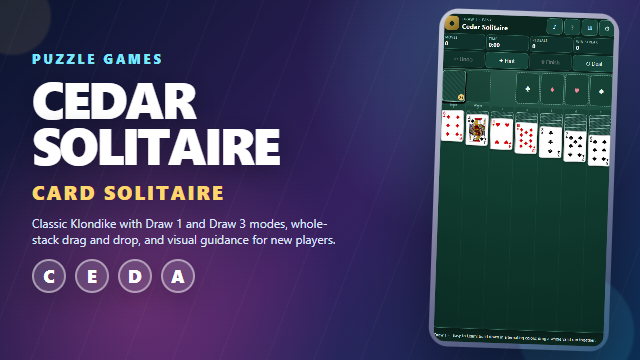
Cedar Solitaire offers both modes, labeled Draw 1 for learning and Draw 3 for the classic challenge, so you can start with one and move to the other when you are ready.
Which column to work first
When you have a choice between two moves, prefer the one that uncovers a face-down card. When both uncover a card, prefer the column with more face-down cards remaining. A column with five hidden cards is a much bigger obstacle than a column with one, and freeing it early gives you more options for the rest of the game.
Worked example: a red 6 is face up in column 2, which has one hidden card beneath it, and another red 6 is face up in column 7, which has six hidden cards. You have a black 7 available to receive one of them. Move the 6 from column 7. You uncover a card in the pile that most needs it, and column 2 can wait.
This is also why you should play from the tableau before turning the stock when you can. Tableau moves reveal hidden cards permanently, while stock cards will still be there on the next pass.
Emptying columns and choosing kings
An empty column feels like progress, but it is only valuable if you have a King to put in it. Since only a King or a King-led run can occupy the space, clearing a column with no King available just leaves an empty slot you cannot use, while the cards you moved to clear it may have blocked something else.
When you do have a King ready, think about which one. If you are holding a red Queen in the waste and a black Jack is stuck in the tableau, a black King is the better choice, because the red Queen can go on it and the black Jack can follow. The wrong King can leave the next cards in the sequence with nowhere to go.
When a King sits on top of face-down cards in a column, moving it to an empty column is often the single most useful move available, because nothing else can ever free those hidden cards. A King at the bottom of a column with nothing under it, on the other hand, is already where it belongs and should usually stay.
When to send cards to the foundations
Aces and twos should go to the foundations right away. Nothing can be built on them in the tableau that would help you, so they only take up space.
Higher cards deserve a moment of thought, because a card on a foundation is no longer available as a landing spot in the tableau. A useful rule: a card is safe to play to the foundation when both opposite-color cards one rank lower are already on their foundations. For example, the 5 of hearts is safe once the 4 of spades and the 4 of clubs are both up, because those are the only two cards that could ever be placed on it in the tableau.
If you are not sure, it is usually fine to hold the card back until you need the space. Cedar Solitaire also allows a top foundation card to come back to the tableau when the move is legal, which can rescue a position where you promoted a card a little too early. In stricter versions that do not allow this, the rule above matters even more.
Cycling the stock wisely
The stock is your reserve, not your first option. A good habit on each turn is to look for every possible tableau move first, then turn the stock only when the tableau has nothing productive to offer.
Cedar Solitaire gives unlimited redeals in both modes, so running out of passes is not the risk. The risk is playing a stock card just because it fits, when it would be more useful later or when it blocks a better move. Ask whether the card helps uncover a face-down card or build toward one. If not, it can usually wait for the next pass.
In versions that limit how many times you can go through the stock, count your passes and spend them more carefully. In Draw 3 especially, plan which waste card you will play on this pass so that the groups shift in a useful way for the next one.
Habits that save deals
Not every Klondike deal can be won, even with perfect play. What you can control is how many winnable deals you lose to avoidable mistakes. These habits catch most of them.
- Do not move a card between two tableau columns unless it uncovers a face-down card, frees a needed card, or creates an empty column you can fill with a King.
- When two equal moves exist, take the one from the column with more hidden cards.
- Check the stock and waste before making a move that commits you, such as moving a long run onto one of two possible targets.
- Use undo to test an idea, then compare it with the alternative before settling.
- Treat hints as a list of legal moves, not advice about the best one. Cedar Solitaire's hint shows one legal move and does not claim it is optimal.
Frequently asked questions
Is Draw 1 or Draw 3 better for beginners?
Draw 1. Every stock card is reachable on every pass, so mistakes are easier to recover from and you can focus on tableau decisions. Draw 3 adds a layer of planning because only every third stock card is playable until you start using the waste.
Can every game of Klondike be won?
No. Some deals have no winning sequence no matter how you play, because key cards are buried in a way that no sequence of moves can free. Good strategy increases the share of winnable deals you actually finish, but it cannot make every deal solvable.
Should I always play cards to the foundation as soon as I can?
Aces and twos, yes. For higher cards, wait until both opposite-color cards one rank lower are on the foundations, or until you actually need the space. A card on the foundation can no longer hold lower cards in the tableau.
Is it a mistake to empty a column without a King ready?
Often. Only a King or a King-led run can fill an empty column, so the space is wasted until one appears. Clear a column when you have a King to place there, or when doing so also uncovers useful cards.
How does moving a whole run work?
You can move a face-up run as one unit when it is in valid descending, alternating-color order and its lowest card fits the destination. In Cedar Solitaire you pick up the highest card of the run you want to move, and every card stacked on it moves along.