
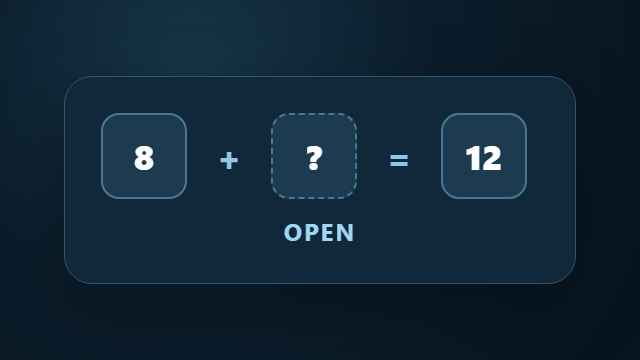
Arithmosaic
Place a finite bank of numbers into crossing equations until every row and column is exactly true.
Finished a round? Try another BeanNest mind game.
Place a finite bank of numbers into crossing equations until every row and column is exactly true.
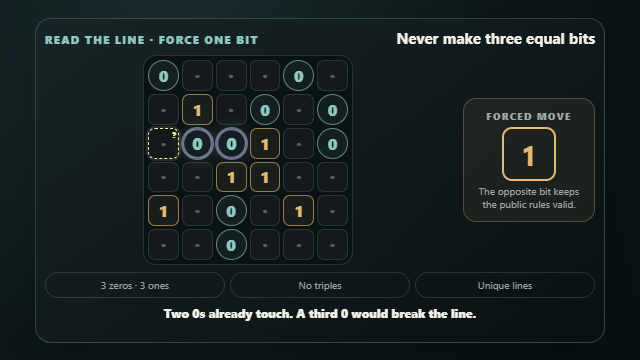
Fill a 6x6 grid with 0s and 1s so every line balances, avoids triples, and stays unique.
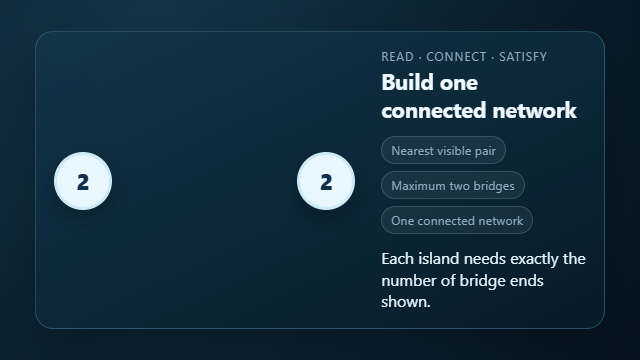
Connect numbered islands with one or two bridges until every island matches its clue and the network is one connected whole.
Rectweave is a calm rectangle-partition logic game: drag rectangles so each visible number owns a block of that many cells. Daily and Free Play support mouse, touch, and keyboard while ordinary moves never consult a secret answer.
Drag from one corner to another to outline a rectangle. A committed rectangle must stay on the board, contain exactly one numbered clue, and cover exactly the number of cells shown by that clue. Keep partitioning until every cell belongs to one non-overlapping clue rectangle. Daily gives the date's reviewed board; Free Play starts another public puzzle.
Neither by itself. The number is the rectangle's area in cells, so a 6 could be a 1x6 or 2x3 rectangle when that shape fits the board and contains exactly one clue.
No. Every committed rectangle must contain exactly one clue, and its cell count must equal that clue.
No. Ordinary play accepts any rectangle that satisfies the public rules. It does not compare each drag with a hidden answer.
Yes. Rectweave uses the established rectangle-partition rule family commonly called Shikaku: each rectangle contains one clue and has the clue area in cells. It is an independent BeanNest implementation, not an official Nikoli product.